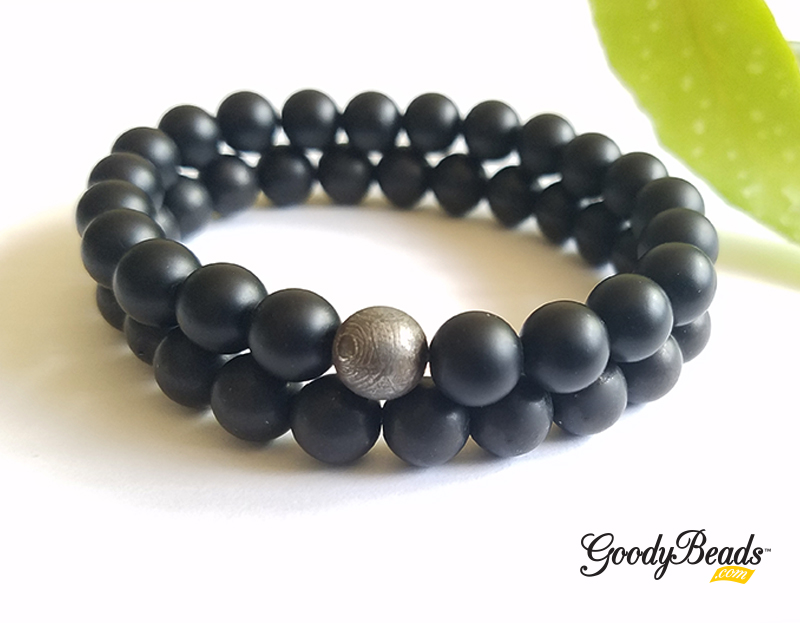
Take a break and breathe. Our DIY today helps ground yourself and bring positivity to the wearer. It consists of Shungite beads, which can “aid in pulling negative energy from the wearer in general, which may help you to keep a more positive, focused attitude” and Muonionalusta Meteorite, which promotes clarity and spiritual growth.
Plus, when you wear these stones, feel its weight. Its solid form has a tangible weight and know that you have a piece of prehistoric stones and ‘out-of-this-world’ kind of beads!
Cut a piece of elastic to 9 inches. Pull and pre-stretch your elastic.
Slide on 23 Shungite beads. (Adjust length by adding or descreasing amount of beads to fit your wrist.)
Make a surgeon’s knot. Cut Excess elastic, leaving a small stub of elastic end.
Repeat all steps for other bracelet, while substituting a Shungite bead for a Meteor bead. Make a surgeon’s knot and cut off excess elastic.
Dakota Stones® – Muonionalusta Meteorite & Care Guide
Blog Post and Information courtesy of Dakota Stones and DakotaStones.com
All gemstones are fascinating and special. They come from far-away, remote parts of the globe. These Muonionalusta Meteorite beads, however, are more special than most, and originally came from much farther away. The meteorite was first discovered in Sweden, nearly 100 miles north of the Arctic Circle, in 1906 by two children who stumbled over a metal object stuck in the ground. Later determined to be an iron meteorite, it was thought to have fallen approximately 800,000 years ago. Other, smaller pieces of the meteorite have been found in the area, spread by the impact with the earth or moved through glacial changes.
Muonionalusta Meteorite requires routine care in both specimen and jewelry form. Once you receive your pieces, it’s important to properly and regularly care for them. This article applies only to the care and keeping of Muonionalusta Meteorite in bead or other “finished” form. Different types of meteorite and meteorite specimens may require different care.
DOs
– Immediately remove from any sealed plastic packaging and put in a dry place with a controlled temperature. – Clean your meteorite thoroughly in anhydrous (water-free) alcohol. Anhydrous alcohols include 95% ethyl alcohol which can be found at hardware or home improvement stores or 99% isopropyl alcohol found in drug stores. – Seal it. Appropriate sealants can be found in hardware stores and include brands like WD-40 or RustGuardIt. You can also use microcrystalline wax, but this process involves prolonged exposure to high heat. – Store in a dry, temperature controlled area. – Store with a desiccant (silica gel packs) and recharge or change them out. – Re-clean and re-seal as needed. The amount, type of wear, or individual wearer can all impact how frequently the stone will need to be cleaned and sealed. – Clean and re-seal after exposure to sweat or heavy or prolonged handling. – Remove rust with anhydrous alcohol and a steel brush.
DO NOTs
– Clean with water. – Store long-term in anything sealed without controlling the moisture in the container. – Submerge in water or use any product including water for cleaning. – Wear while exercising or in environments where the piece will be in contact with a high amount of sweat and moisture. At Your Own Risk: Seal with lacquer or acrylic agents. They can alter the appearance of the piece and be difficult to remove. They are also NOT a permanent solution or impervious to moisture.
Dakota Stones® Carbon-Based Minerals: Shungite
Blog Post and Information courtesy of Dakota Stones and DakotaStones.com
Shungite is a modern material, the first instance of the name being coined only dating back to 1879. Then, the material could refer to any mineral with shungite inclusions– and at the time, this meant just about any stone with carbon inclusions. Over time, we’ve been able to identify what makes shungite special– which comes from the biological material it comes from. The name is derived from where it was discovered, like many other minerals — Shunga, Russia, has the largest deposits of shungite. Shungite is also almost exclusively sourced from Russia, and the mineral has been illusive in most other places in the world.
What we do know now is that shungite is almost entirely carbon. Carbon is an organic compound, and an excessively abundant element found in the earth’s crust. Carbon is also found abundantly within our bodies! We do know that because of this, shungite was likely a prehistoric plant or animal of some kind, that remained buried in the earth’s crust for thousands of years, the pressure and age transforming it into a close relative to carbon. We have yet to discover exactly what these organisms were, but they likely came from prehistoric swamps and volcanic ash.
Shungite has a non-crystalline formation, making it brittle in its raw form and very desirable for pigments in paints. Carbon-based black paint has been a new scientific and artistic achievement in the last decade. These paints create a depthless, abyssal black that absorbs all light. Looking at these extremely dark paints have created scientific opportunities, such as hiding satellites from view in the night sky. For artists and goths, this new black is an exciting opportunity, but these paints have yet to hit the mass market for regular consumption. You may need to wait a little while longer to obtain a piece of clothing that will finally let you become one with the void– but the possibility is definitely within our lifetime.
Because these shungite beads are highly carbon-based, they are very light in comparison to other black alternatives. Compared with onyx, a dense, chalcedony-based mineral, does provide a rich black. However, shungite has a unique, metallic appearance. One could compare it with graphite, which is made primarily from carbon, since it does have a lusty appearance. These beads could look sleek when paired with crystal quartz for a monotone design. Their dark color could be a nice spacer bead to provide breathing room in more colorful designs. If you’re designing something with our meteorite beads, they could make a light alternative, as meteorite is mostly iron, and tends to be somewhat heavy.
The metaphysical properties of shungite tend to be very attractive to customers who desire to protect themselves from EMFs. Carbon is an especially conductive material, so it is said that wearing these beads can help direct the flow of unwanted energies through the stones, rather than the wearer. These stones can also aid in pulling negative energy from the wearer in general, which may help you to keep a more positive, focused attitude.