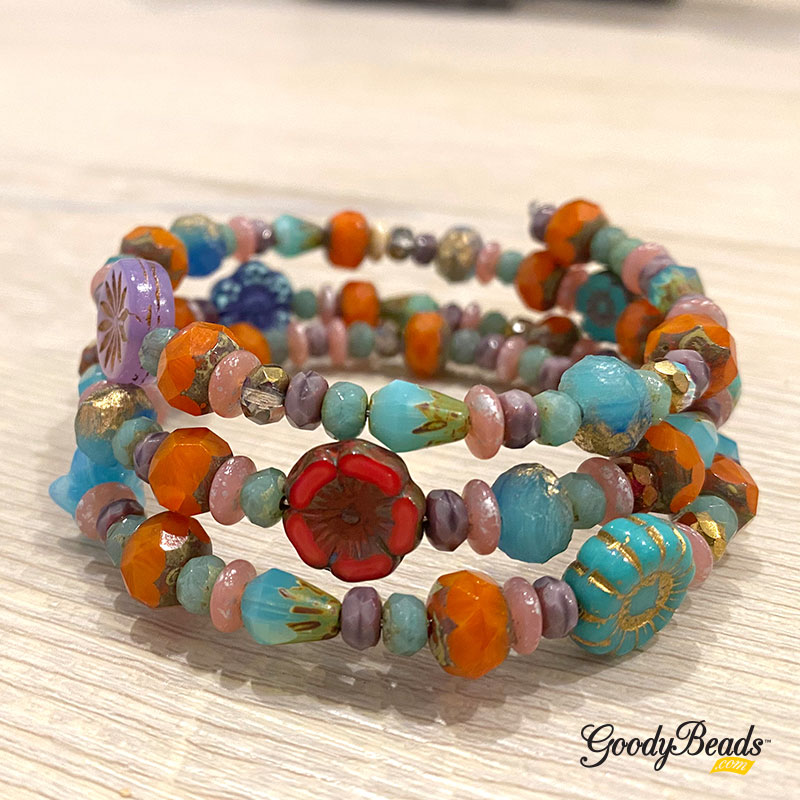
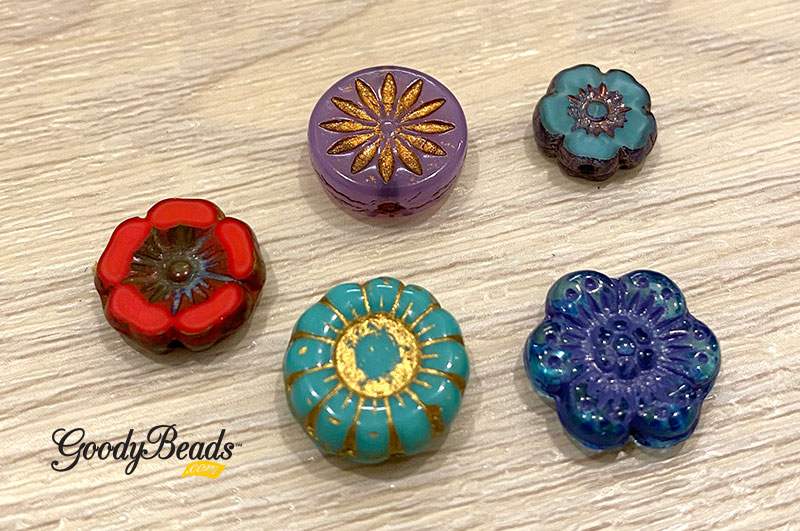
Spring into Spring with a flowery wrap bracelet with Czech flower beads. We’re featuring a variated design with Raven’s Journey Czech beads strung on memory wire.
Make a simple loop to one end of your memory wire and slide on a few Czech beads. This sequence does not have to be planned and can be random. This is the natural beauty of this design. Then slide on one of your flower beads and repeat.
DIY Gemstone Donut & Deerskin Necklace
Today’s DIY Gemstone Donut and Deerskin Necklace features three of our favorite brands. Dakota Stones gemstone donuts, LeatherCord USA deerskin lace and TierraCast barrel bead.
Cut deerskin lace in half (if you’re using the 2 meter product item) or cut 3.5 feet of lace.
Fold lace in half and slide through gemstone donut and make a lark’s head knot. Make sure the front side of the lace is facing outwards and evening out your lace ends.
Slide barrel beads through both lace ends and slide to sit on top of lark’s head knot.
Make an overhand knot to both of your lace end to complete your necklace.
DIY Flower Blossom Necklace
Spring is here and flowers are blooming! So we have this sweet DIY flower blossom necklace.
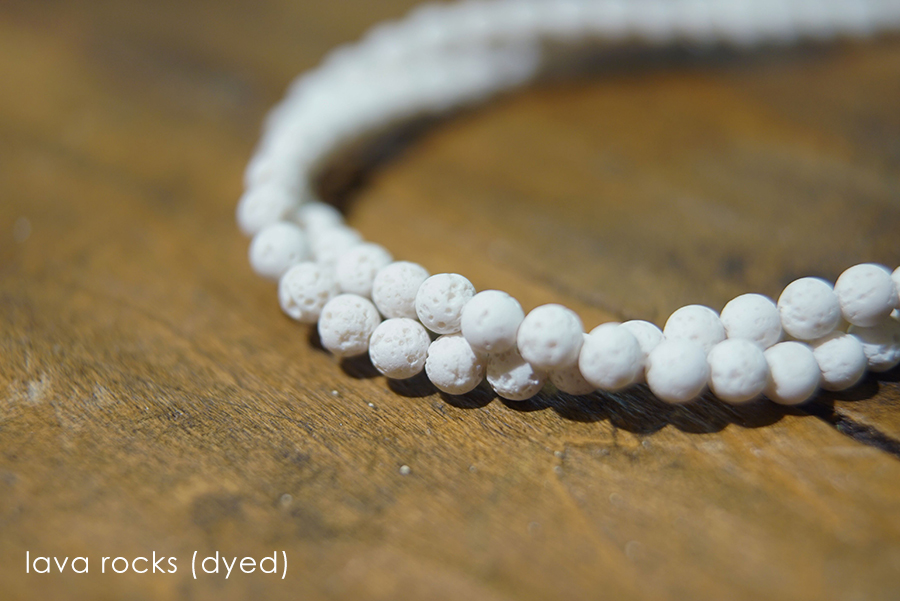
With modern advancements in stone cutting and treatment technology, color enhancements and dyes have arrived at the forefront of the beading and natural stone market. Sometimes, a dye is selected for a stone to enhance the color, or to change it all together. These dyes can be synthetic or natural pigments, and are usually applied to a stone after the tumbling process and before any other finishes may be applied.
Dyed stones may appeal to designers with bright and bold taste, as the pigments achieved with dye are unrivaled. They can be useful for designers who want to appeal to consumers with smaller budgets, or for starting-out beaders who want to practice techniques without worrying about possibly damaging costly materials. The most commonly dyed stones are stones with pre-existing transparency, like Crystal and some Agates. A rough, natural look is also favorable, with stones like Jasper and White Howlite that provide different rings of material to add depth to additional color.
Sometimes, a dye is sold to mimic the appearance of more expensive gemstones, and can be so convincing that it flies under the radar of even some of the most knowledgeable consumers in the industry. The problem is not the existence of dyed stones, but rather the dishonesty when a retailer wants to misguide customers. Such is infamously the case with turquoise, which is one of the most heavily copied gems on the market. When dyed stones were a more novel product in the early 20th century, it was easy for scam artists to bank on their consumers lack of knowledge to deceive them. For these reasons, dyed stones gathered an unsavory reputation for being cheap, dishonest alternatives to natural, untreated stones.
As a reaction to this, the American Gem Trade Association (AGTA) created the “Enhancement Code” for consumers to refer to when researching materials. “Enhancement” does not just refer to dyeing stones either. This system is used to describe any alterations to a stone that can affect the color, quality, and properties of certain minerals. While some people may argue what makes a stone “synthetic,” the AGTA made sure to reference any alteration in a stone’s chemical of physical makeup.
Fortunately for the process of dying stones, new relevance has spurred up as new techniques have been developed. Heat treatments and finishes have been improved, which has allowed dyed stones a second chance. Today, dyed stones can stand on their own on the market as unique, instead of solely as imitations of other stones. Dyes are also occasionally used to enhance a color to create a more uniform color appearance. Different dyes have also made it possible to make powdery, subdued color stones for designers and customers with more understated taste.
It is important to note that at Dakota Stones, we do not condone any dishonesty regarding the alteration of stones. All of our dyed stones, and any chemical treatments or enhancements are marked accordingly. The process of treating stones with dye has improved leaps and bounds since its infancy, and buyers can rest assured that dyes will not rub off of the stones with excessive wear, or when introduced to natural oils from human skin.
People have been cutting and shaping stone manually since the fourteenth century. While we have nearly perfected any and all methods we can manage by hand, technology has since grown beyond our capabilities.
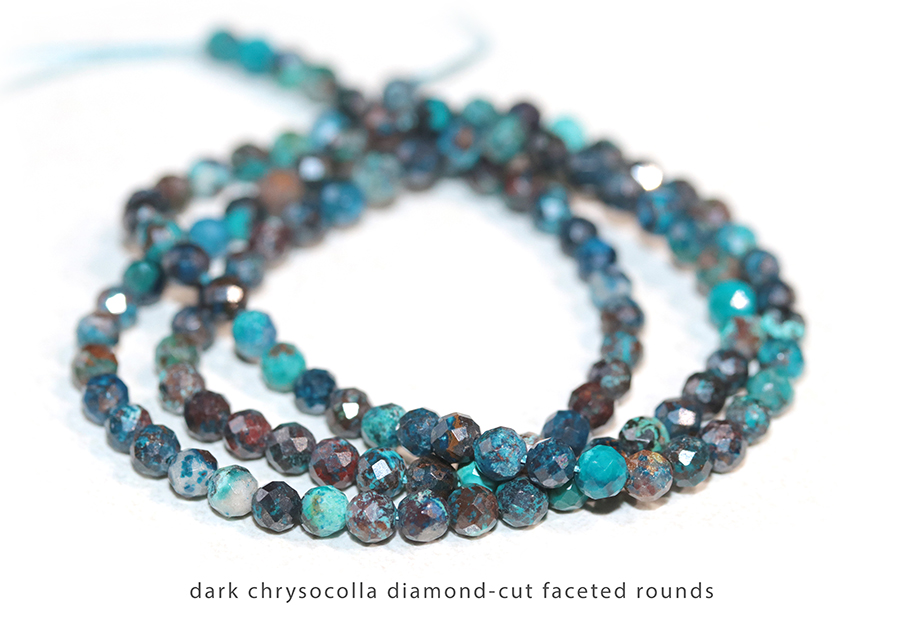
Today, most of our faceted stones are machine cut with industrial-grade diamonds. With the use of new technology, geometry and an understanding of light, which is extremely important for precious stones with strong dispersion, we can now make the facets on each stone cleaner, sharper, and more consistent with minimal or no need for polishing. This means we can manufacture mathematically precise cuts on extremely small surfaces while getting the same luster and shine as we would see on large surfaces.
What this also means for the stone cutting industry is that, not only can we source precise diamond-cut stones at reasonable cost, we have more time and opportunity to focus on the best cuts from minerals that might require hand-cutting. And, as we know, we cannot program a machine to have taste or skill when making unique or difficult cuts. Most of our pendants and cabochons are still beautifully hand-cut by skilled lapidary artists.
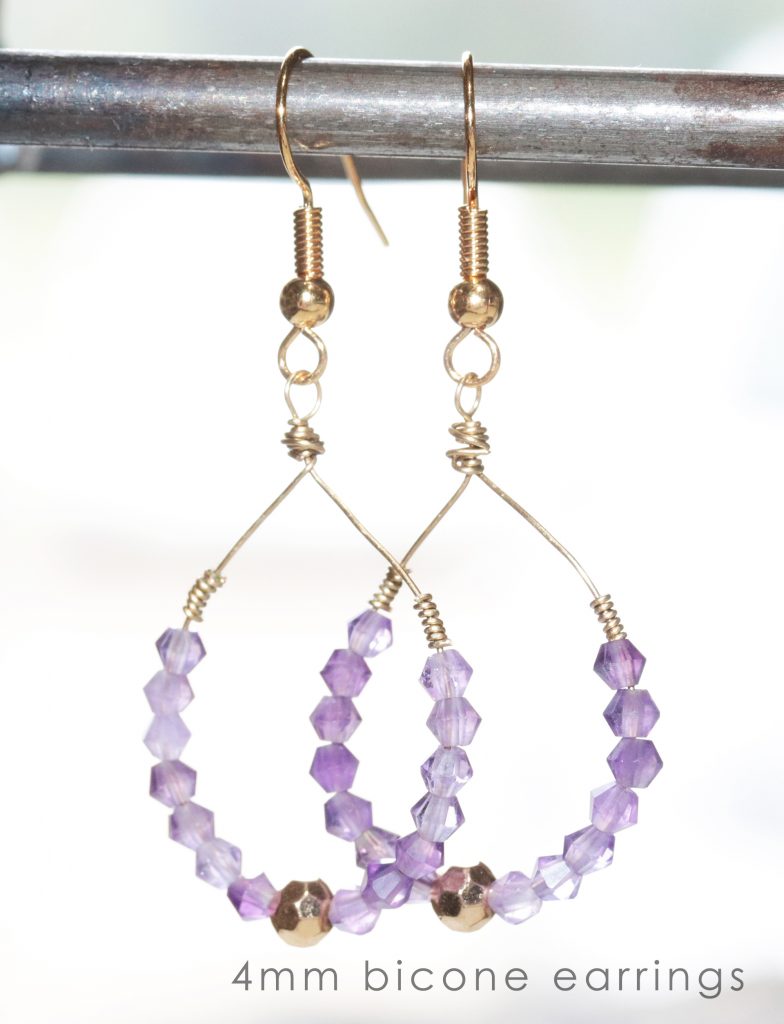
In the past few years Dakota Stones has been one of the first to offer gemstones in diamond-cut bicones, coins, rounds, rondelles and cubes. We are also pleased to be the first to showcase our newest double-hearted star cut stones. As diamond-cutting becomes more and more advanced, we are privileged with the ability to source these unique cuts of stones, with almost undetectable facets at first glance. Our double-hearted strands are a twin to our star-cut line, with an extra triangular facet for additional light refraction.
As diamond-cut stones become increasingly popular we hope to continue innovating new shapes and growing with this incredible technology.
Delicate Delica Wrap Bracelets with Memory Wire
11/0 Miyuki Delica Mixes are some of our newer items here at GoodyBeads. And an interesting way of designing with them are some simple Memory Wire Bracelet. They are perfect for all ages and also the perfect bracelet to wear in warm summer months!
Memory Wire WR00126/WR00127 – Item used in bracelet WR00126 Note: do not use the Heavy or Extra Heavy Memory Wire. The thickness may not fit the Delicas.
Make a simple loop to one end of your memory wire.
Slide on Delica seed beads on memory wire. Make two wraps or more.
Cut excess memory wire leaving a 1/4″ end. Make a simple loop.
DIY Jewelry with Swarovski® Around the World: Austria
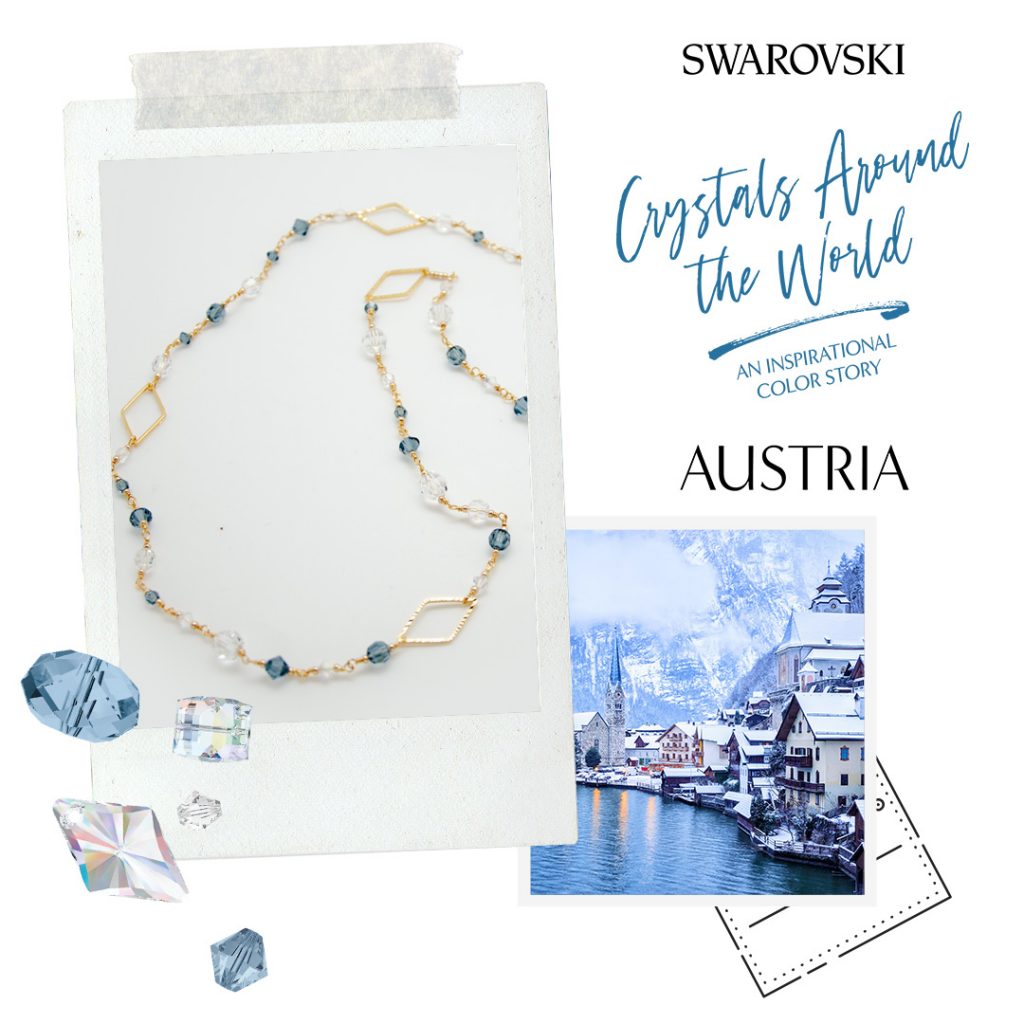
Take a trip to Austria for this month’s destination. Find out how majestic and traditional this country is from its humble villages to intricate architecture to the majestic mountain. Plus, venture the cool hues Swarovski suggests to inspire your Austria trip along with a DIY jewelry project for you to try.
Austria
Austria may be one of Europe’s smallest countries, but it is also one of the most popular destinations in the world. Whether you’re traversing across its drawbridges or hiking up the Alps, the region’s roaring waters and crisp mountain air will greet you as if you were home. The inspiration of these pieces is derived from a multitude of Austria’s most iconic wonders — deep valleys, vast farmland, whimsical woodlands, raging rivers, and of course, its majestic mountains.
Here are some fun facts:
Swarovski Kristallwelten or Swarovski Crystal World is located in Austria – featuring a garden, sculptures and playground!
“Sound of Music” was filmed and set in Salzburg, Austria.
Many of the Classical music icons were born and lived in Austria, such as Mozart, Beethoven, Strauss, Schubert, and others.
Arnold Schwarzenegger was born in Austria
The first zoo was established here.
Austria – Swarovski Colors
Swarovski Create Your Style, has selected three colors to depict the majestic sites of Austria:
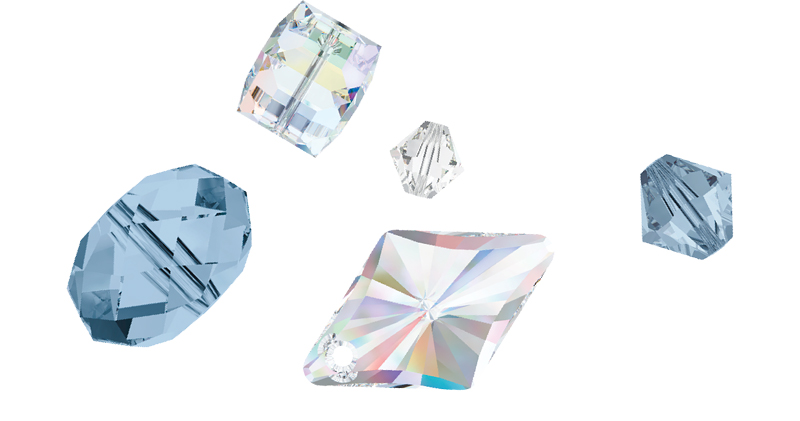
Crystal Clear
Crystal Clear AB
Denim Blue
Austria Inspired DIY Jewelry
Using a variation of round and bicone beads in the three colors, we made a chain link necklace by making wrapped loop links. Refer to our Wire Wrapped blog post on a visual tutorial.
Make a wrapped loop to one end of a 2-3 inch piece of wire. Slide on a seed bead, crystal and seed bead. Make another wrapped loop.
Create another wrapped loop while sliding on link you made in step 1 before completing the loop. Slide on a seed bead, crystal and seed bead. Make another wrapped loop.
Repeat step 2 with various different of crystals to create 7-10 links. With the last link wrapped loop, slide on the diamond link before completing the wrapped loop.
Make next set of wrapped beaded links, linking the diamond link in Step 3.
Repeat to your desired length. We made a length of 28 inches.
Open jump ring of the bracelet sliding clasp and link each end of your beaded links to clasp.
As an alternative, you can use 20 gauge wire and make simple loops to create your beaded links.
DIY Morse Code Necklace with Delica Seed Beads
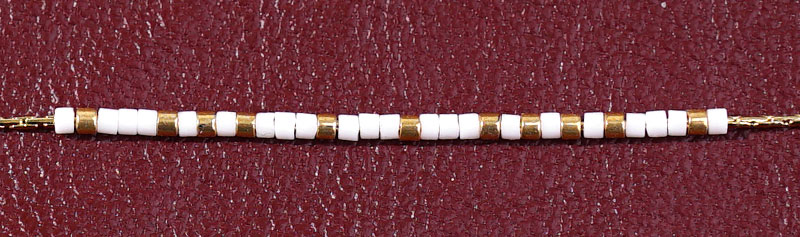
Design delicate and minimalistic necklaces with a secretive morse code, using Miyuki Delica seed beads, strung on beading chain.
Morse Code Letters
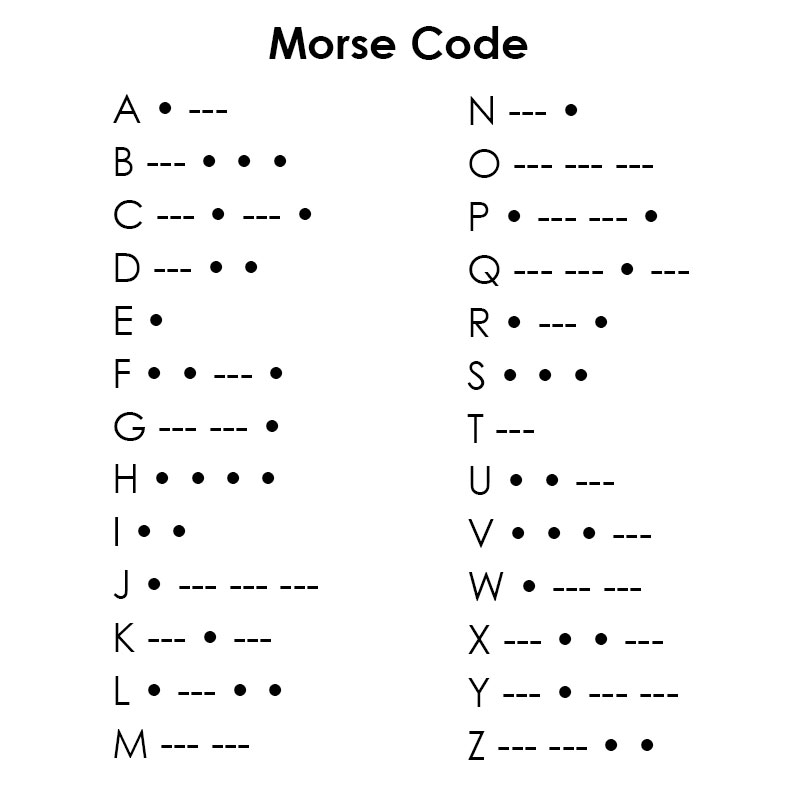
Morse code is a type of telecommunication invented in the early 19th century that takes texts and converts them into dots and dashes. Each letter has a series of dots and/or dashes. Here is what they look like:
Pack your bags because you are invited to embark on a 6 month journey around the world to celebrate Swarovski’s 125th anniversary. Each place we visit will bring:
New Destination and inspirations
Sparkling color combinations
and Beautiful Swarovski inspirational projects
We will explore how color combinations act as a global identifier – just as a flag does for its country.
This global experience will begin this month of April through September and you don’t need a passport to enjoy the ride. Here is what you’ll expect for the months to come: